
What if the most important question before signing a DeFi transaction is not “Which wallet is connected?” but “What will this transaction actually do?” That distinction matters because a wallet is no longer merely a place to view balances or approve a connection. For users moving between Ethereum-compatible networks, decentralized exchanges, lending markets, bridges, and token contracts, the wallet has become an interpretation layer between human intent and machine-executed code.
This is the central value of a Rabby wallet extension: it is designed around the practical problems created by multi-chain DeFi. A browser extension can make signing convenient, but convenience alone is not safety. The more useful model is a wallet that helps the user inspect the proposed action, identify likely consequences, and recognize when a transaction differs from what the interface appears to promise. Transaction simulation is important because it moves review from abstract permissions toward an estimate of the transaction’s resulting state.
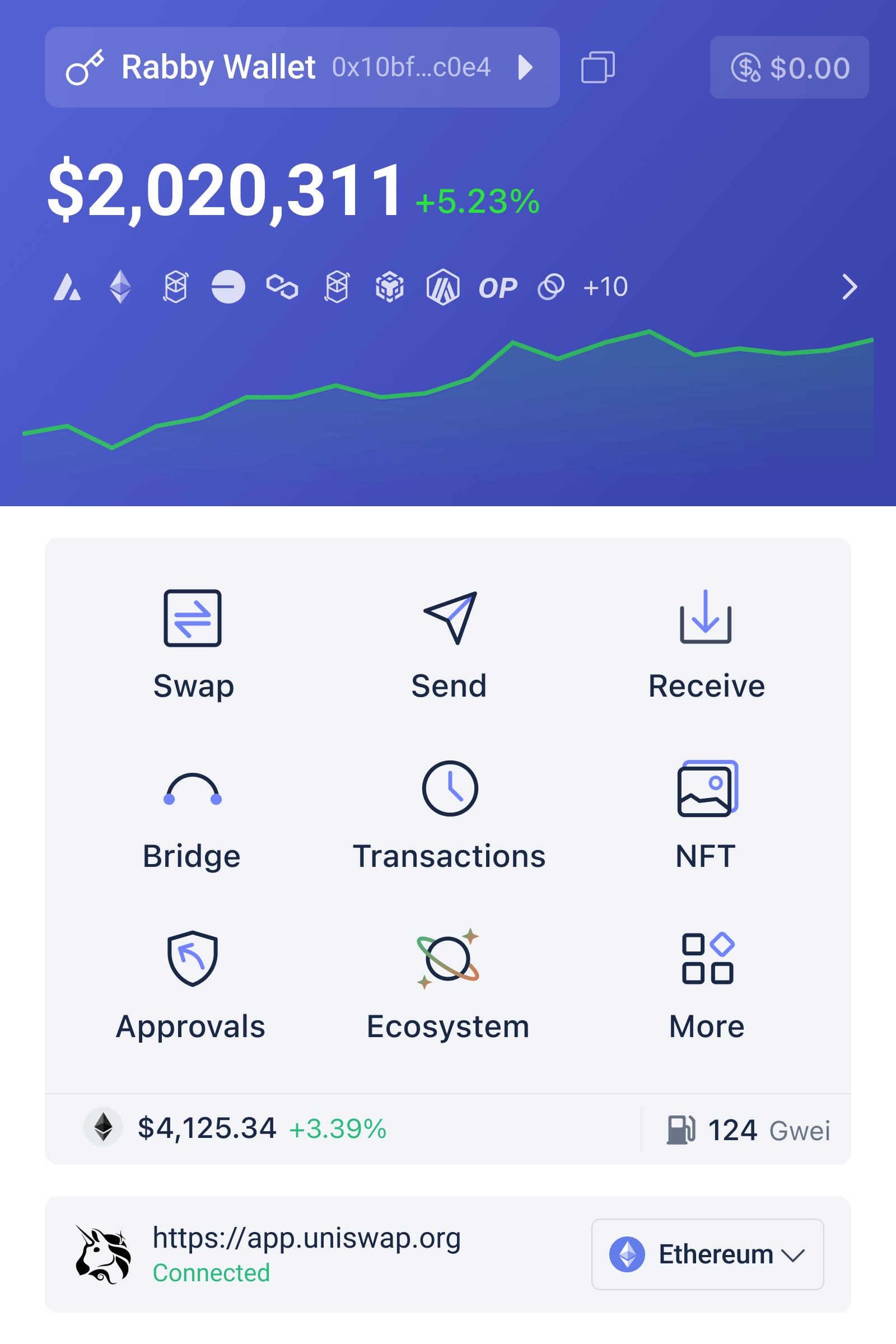
The multi-chain problem is really a context problem
“Multi-chain wallet” sounds like a feature category, but it describes a difficult reasoning task. A DeFi user may hold the same token symbol on several networks, interact with contracts that have similar names, and switch between chains without changing the familiar shape of a website. Yet the network, contract address, liquidity conditions, gas asset, and security assumptions can all be different.
This creates a subtle risk: visual familiarity can conceal technical difference. A token labelled USDC on one network is not automatically interchangeable with a token carrying the same label elsewhere. A decentralized application may also request a token approval that remains active after the immediate trade, or route a transaction through several contracts that the user never sees in the front-end description. The wallet therefore has to preserve context: which chain is active, what asset is being used, which contracts are involved, and what authority is being granted.
For users in the United States, this context is especially practical rather than theoretical. DeFi activity often spans major networks, layer-2 systems, and application-specific environments, each with different fee behavior and transaction timing. A failed transaction can still consume gas. A poorly understood approval can expose assets later. A bridge transaction can involve waiting, relaying, or additional steps that are not equivalent to an ordinary token swap. A multi-chain wallet cannot remove those differences, but it can make them harder to overlook.
Readers who want to install the browser extension should treat the rabby extension download as the beginning of a verification process, not the end of one. Installation should be followed by checking the extension’s source, confirming the correct network, and using a wallet setup in which the recovery phrase is never entered into an untrusted website. The browser wallet is an interface to private-key operations; it is not a substitute for operational discipline.
What transaction simulation actually does
A transaction is usually represented as a request to a blockchain node: call this contract, with these parameters, from this address, while paying a specified fee. Before the transaction is finalized, software can often execute a simulated version against an available blockchain state. This does not publish the transaction or move funds on-chain. Instead, it estimates how the call would behave under the state used for the simulation.
The result can reveal more than a basic confirmation window. Depending on the transaction and the information available, simulation may help identify the tokens expected to leave the wallet, the assets expected to arrive, approvals being changed, contract interactions, and whether the call appears likely to revert. In plain terms, it attempts to answer: if this action were executed now, what would the wallet’s state probably look like afterward?
That “probably” is important. Simulation is not a crystal ball. The blockchain state can change between simulation and inclusion in a block. A decentralized exchange price may move, liquidity may be consumed by another trade, a contract may depend on time or block conditions, and a relayer or bridge may introduce behavior outside the simplest local execution model. A simulation can therefore improve decision quality without guaranteeing an outcome.
The non-obvious insight is that transaction simulation is best understood as a form of executable explanation. A static warning says that a contract is requesting an approval. A simulation tries to show the practical consequence of that request in the current context. The difference resembles reading a legal permission in isolation versus seeing the operation it enables. Neither replaces judgment, but the latter is often easier to evaluate.
Why warnings and simulations are not the same thing
Wallet warnings and transaction simulations address different layers of risk. A warning may flag a suspicious address, an unusual contract, a large approval, or a network mismatch. Such signals are valuable because some risks are reputational or structural rather than directly observable in execution. A simulation, by contrast, focuses on what the transaction appears to do when executed against a particular state.
Consider a token swap. The simulation may show the outgoing token and the estimated incoming token, while a warning system may separately draw attention to an unlimited approval or an unfamiliar contract. One tool describes likely effects; the other may describe conditions that deserve caution. A responsible DeFi workflow uses both, then adds a third layer: the user’s own confirmation that the action matches the intended trade.
There are also failure modes that simulation cannot settle. A malicious contract can behave differently under different conditions. A user interface can misrepresent the economic purpose of a transaction even when the low-level call executes successfully. Slippage can turn an apparently reasonable trade into a poor one. Smart-contract vulnerabilities, oracle failures, governance attacks, bridge dependencies, and compromised front ends remain broader protocol risks. Simulation may expose the transaction’s mechanics while saying little about whether the underlying strategy is wise.
A practical review method for DeFi transactions
A useful habit is to review a transaction in four passes. First, confirm the network and the asset. Ask whether the wallet is connected to the intended chain and whether the token contract is the one you actually mean to use. This prevents a common category of error: making a technically valid transaction in the wrong environment.
Second, inspect the authority being granted. A swap often begins with an approval, and an approval can outlast the trade. Check which token is covered, which spender receives permission, and whether the amount is limited or broad. A limited approval may be less convenient, but it narrows the potential impact if the spender is later compromised.
Third, read the simulated outcome as a balance-change statement rather than as a green light. What leaves the wallet? What enters it? Are there unexpected tokens, fees, or contract calls? Does the result depend on a minimum received amount, a deadline, or another constraint? This turns a wallet confirmation into a small accounting exercise.
Finally, consider what the simulation cannot know. Is the protocol trustworthy? Is the quoted price acceptable? Could the transaction be reordered or become stale? Is a bridge being used despite its additional trust assumptions? This last pass is where experienced users differ from purely interface-driven users: they do not confuse “the transaction will probably execute” with “the transaction is economically or operationally safe.”
Where the model breaks—and why that still matters
Simulation depends on an observed blockchain state and on the ability to reproduce the relevant execution path. If state changes rapidly, the simulated result can become outdated. Some applications also rely on off-chain signatures, private order flow, external relayers, asynchronous messaging, or later callbacks. In these cases, a local preview may capture only part of the full process.
There is a further human limitation. Detailed information can create false confidence. A user may see a clean balance-change summary and stop asking whether the protocol is reputable or whether the trade makes sense. Better visibility reduces some forms of error, but it does not eliminate social engineering, rushed decisions, or misunderstanding of financial risk. The right expectation is not perfect protection; it is a more informative checkpoint before an irreversible action.
That limitation also points to a broader direction for wallet design. If multi-chain applications continue to make transactions more composable, wallets may increasingly be judged by how well they explain intent rather than by how many networks they support. Conditional scenario: if simulation becomes more reliable across complex applications, users could compare not only expected balances but also permissions, timing assumptions, and failure paths before signing. The evidence needed to support that shift would be better handling of cross-chain and asynchronous actions, not simply more warning labels.
Frequently asked questions
Is a multi-chain wallet safer than using separate wallets?
Not automatically. A multi-chain wallet can reduce friction and improve visibility across networks, but its safety depends on the quality of transaction review, the protection of the recovery phrase, the legitimacy of connected applications, and the user’s handling of approvals. Consolidated access can also concentrate risk, so substantial holdings may warrant separate accounts or hardware-based signing practices.
Does transaction simulation guarantee that a transaction is safe?
No. It estimates execution and may reveal expected balance changes, approvals, or likely failures. It cannot guarantee future blockchain conditions, protocol solvency, price quality, contract security, or the behavior of every off-chain component. Treat simulation as an evidence-based review tool, not as an endorsement of the transaction.
What should I check before installing a Rabby browser extension?
Use a trusted source, verify the extension details, and never disclose a recovery phrase to a website or support contact. After installation, confirm the active network, test with a small amount when appropriate, and review transaction simulations and approvals before signing meaningful DeFi actions.
The strongest case for a Rabby wallet extension is therefore not that it makes DeFi risk disappear. Its practical significance lies in inserting interpretation between a website’s request and the user’s signature. In a multi-chain environment, that pause is where network identity, permissions, expected outcomes, and uncertainty can be examined together. The wallet is most useful when it helps users ask a better question than “Can I sign this?”—namely, “Do I understand what signing this is likely to cause?”